Coordination Is Learned, Not Switched On
Learn movement coordination by practising one clear part at a time, spotting what changes and choosing a useful next adjustment without chasing speed.
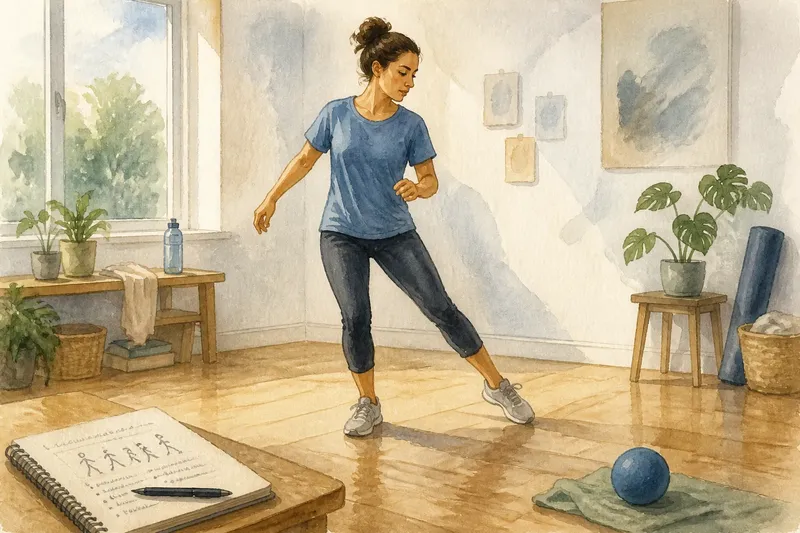
The common mistake in learning coordination is repeating the whole movement at full speed and hoping the awkwardness wears off. It costs attention: the same snag gets rehearsed while its cause stays hard to spot. Movement coordination is easier to practise when you choose a manageable part, observe what happens and adjust one thing at a time.
Attention before repetition
Repeating a movement can build familiarity, but familiarity is not the same as learning. If your feet keep crossing during a side step, repeating the same fast sequence may make that crossing more habitual. Give each attempt a clear point of attention: where your weight moves, which foot leads or when your arms change direction.
Choose one cue for a short bout of practice. In a simple step-touch, you might focus on placing the leading foot before bringing the other foot beside it. Keep the rest of the movement comfortable and uncomplicated. Once that detail is easier to notice, shift attention to another part rather than collecting several cues at once.
Not every skill can be neatly separated into parts. Breaking a sequence down is simply a way to inspect it. A dance step, gentle ball toss or balance pattern may involve several actions, but practising one relation at a time can help you spot where the timing changes.
A week of useful practice
Use this routine as a flexible week, not a test. Choose one low-risk movement that suits your space and current ability, such as a step-touch pattern or a soft toss with a light ball. Keep each session brief enough to stay attentive. Stop if discomfort or loss of control makes the movement feel unsuitable. The aim is to make observations, not to accumulate repetitions.
- Day one: notice the whole. Perform the movement slowly and comfortably. Identify the part that feels least clear, using plain words such as “I lose the rhythm when I change direction”. Do not try to correct every detail yet.
- Day two: isolate one relation. Practise only the awkward transition at an easy pace. For a step-touch, place one foot to the side and bring the other beside it, without adding arm movements. Pause between attempts and consider whether the cue was easier to follow.
- Day three: leave a gap. Skip deliberate practice, or use the movement casually if it comes up. A gap can keep practice from becoming a dutiful blur. There is no need to compensate with a longer session later.
- Day four: reconnect two parts. Join the transition to the action before it, still at an unhurried pace. Keep the earlier cue so you can notice whether the parts work together more clearly.
- Day five: vary one feature. If the sequence feels controlled, change one modest detail, such as facing a different direction or using a different rhythm. If that makes the original problem hard to notice, return to the simpler version.
- Day six: practise in context. Try the movement as part of a short, familiar sequence. Keep the setting clear and uncrowded; do not add speed merely to make the task feel more serious.
- Day seven: review and choose. Repeat the easy version, then note what feels clearer and what remains uncertain. Decide whether to keep practising the same skill, simplify it or move to a related movement.
Say you are learning a gentle side-step pattern and your trailing foot keeps crossing behind the leading one. In the first session, you notice the crossing but do not chase it at speed. In the next practice, you work only on stepping sideways and bringing your feet together. Later, you reconnect that action to the rhythm. The observable change you are looking for is not a perfect routine, but the ability to identify the crossing sooner and choose an adjustment.
Attentive practice cues
Use a few simple questions during or after a bout:
- Which part of the movement did I mean to notice?
- Did I stay in control enough to observe it?
- What changed when I slowed down or removed another action?
- Can I name one adjustment for the next attempt?
If you cannot answer any of them, simplify the task. Reduce the range of motion, remove the arms, slow the rhythm or practise without a ball. A movement that is easier to observe can be more useful than a complicated version performed on autopilot.
Distinguish a cue from a verdict. “Place the foot beside the other” gives you something to do. “I am hopeless at this” gives you nothing to adjust, though it is a familiar way to waste a perfectly good practice period.
When should you change the task?
How many repetitions should I do?
Stop when attention starts to drift or the movement becomes less controlled. A fixed count is less useful than noticing whether you can still follow the cue and tell what happened.
Should I practise slowly?
Start at a pace that lets you notice the parts and keep the movement comfortable. Add a little speed only while the sequence remains clear; speed is a variation, not proof of learning.
What if I keep making the same error?
Make the task easier by removing a component or reducing its range. Choose one cue and see whether the error becomes easier to notice and adjust.
When should I try a variation?
Try one small change when the current version feels controlled and you can still attend to your cue. If the change makes the movement confusing again, return to the simpler form and build from there.
Useful variation, not novelty
Variation can help you notice what a movement depends on, but changing everything at once muddies the picture. Keep most features familiar and alter only one: direction, rhythm, starting stance or the presence of a light object. Then you can notice whether the movement still makes sense under a modest change.
For example, a step-touch practised facing a different wall changes orientation without requiring new equipment or a more demanding sequence. If you lose the pattern, return to the original direction, regain the cue and try the variation another day. There is no prize for making a simple task complicated.
Elaborate drills are not worth the effort before you know what needs attention. A new app, a crowded sequence or a faster beat can add noise without clarifying the skill. Begin with the movement, enough clear space and a cue you can remember.
Choose the next attempt
At the end of the week, base the next practice on what you observed. If one transition remains unclear, keep working on that part. If the parts connect comfortably, keep the same cue while adding a small variation. If the movement feels unsuitable or uncomfortable, choose another task rather than forcing progress.
Coordination develops through attention as well as repetition. A useful practice leaves you with a specific observation and a sensible next adjustment. That is a better reason to return to a movement than the mere fact that you have done it many times.